Invoices: billing built into the field-service workflow
I led the design and product definition of Menaia's first-party invoicing system, letting service businesses bill clients, take payments, and track balances without ever leaving the platform.
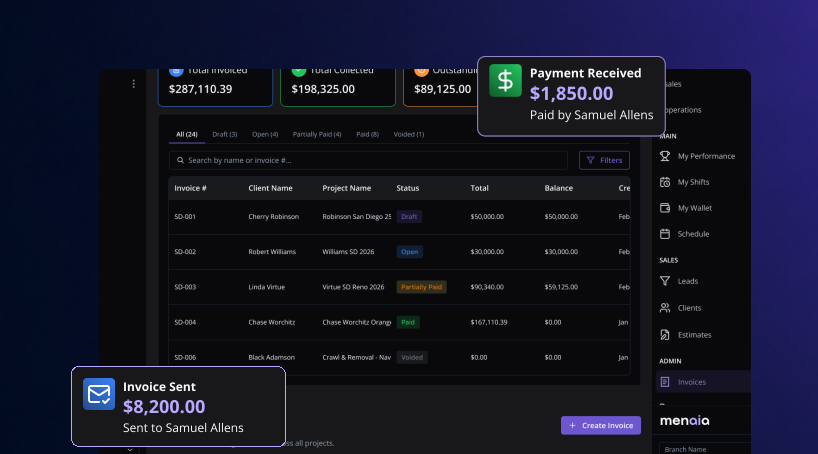
Menaia takes a service business from first lead to finished job (estimates, scheduling, the works) but stopped short at the one step that actually pays the bills: getting paid.
Menaia is an operations platform for home- and field-service companies. On it, teams win a lead, build an estimate, get a proposal signed, and run the job without leaving the platform. But to invoice the client and chase payment, they had to drop out to a separate tool — a break that cost time, forced manual re-entry, and scattered financial data across systems that never quite agreed.
Phase 1 set out to close that gap. The goals:
- Bring invoicing fully in-house, inside the workflow teams already live in every day.
- Automate the manual work, giving organizations a system flexible enough to take the repetitive billing tasks off admins' plates.
- Surface clear balances and statuses across every project, so owners can see what they've earned and what they're still owed at a glance.
- Lay the technical and design foundations for online payments and accounting sync, so later phases extend the system rather than rebuild it.
I treated this as a systems problem before a screens problem. Before designing a single invoice, I needed to understand how these businesses actually bill — and where the manual work was hiding.
Discovery & Research
The project kicked off with qualitative research. I ran multiple user-testing sessions to learn how field-service businesses handle invoicing today inside their existing software — what worked, what didn't, and which frustrations surfaced again and again.
The goal wasn't to rebuild functionality they already had elsewhere. It was to understand the core problems admins face day to day, so we could lay down the foundational billing tools and solve pain points they'd been living with for years.
Ideation & Iteration
Research pointed clearly to two paths. Smaller organizations needed the flexibility to spin up a quick, custom invoice on the fly. Enterprise teams needed to pull invoices straight from signed proposals — cutting manual re-entry and the risk of the same numbers living differently in two places.
I designed both flows from low to high fidelity, running user-testing sessions at every stage to gather feedback and confirm I was heading in the right direction before committing to the build.
Technical partnership
Throughout, I partnered closely with my engineering counterpart. As I designed, we were jointly shaping the backend infrastructure and data models the system would sit on.
That early collaboration meant the foundations were laid deliberately — built to integrate with Stripe for payment processing and QuickBooks for accounting down the line, rather than bolted on after the fact.
Phase 1 shipped the full core invoicing surface (creation, payments, and financial visibility) plus a settings area that lets each organization tailor how billing works for them.
Phase 1 was designed as the foundation for a deliberately phased roadmap. What we learned shaping the core directly set up what came next.
- Online payments (Stripe Connect) Phase 2 layered hosted payment collection on top of the Phase 1 ledger, with Menaia as the platform and each business as a connected account. Because statuses were already derived from transactions, Stripe webhooks could record payments through the same model, with no rework of the status logic. [Add adoption / time-to-payment impact once available.]
- Loosening the rules for real-world edge cases Some of our early safeguards proved too strict once the system met real billing behavior. Overpayments were the clearest example: they happen often, so rather than blocking them, we updated the system to accept an overpayment and flag it to admins as an over-balance to be reconciled — handling reality instead of fighting it.